
Published: January 27, 2026
Investors continually look for strategies that balance growth, income and resilience, while headlines often focus on short term market movements, long term results are built through fundamentals and dividends remain a powerful and often underappreciated component of total return. As we look ahead, it is a good opportunity to revisit why dividend paying companies have historically played such an important roll in a portfolio and why they may continue to do so. As a quick recap, a dividend is the portion of corporate earnings that a company distributes to its shareholders. We feel this is a great time reflect upon the last year and focus on five key benefits of dividend stocks:
1) Dividend Companies Can Provide Higher Returns
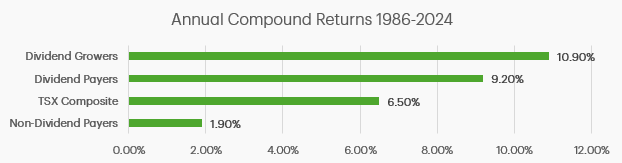
According to RBC Capital Markets Quantitative Research, companies that pay and grow their dividends had the best overall returns between 1986 to 2024:
Source : RBC Capital Markets
2) Dividends Can Account for Significant Returns
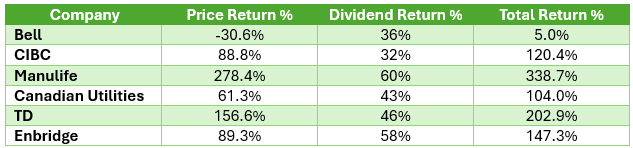
Dividend paying stocks generally provide a steady income stream which can help to reduce the volatility of a portfolio when markets decline. The income they provide also helps add to the total return.
Back in April 2020 during COVID, we highlighted an article on 6 dividend stocks.
Source: FactSet Mar 23, 2020 – Dec 11, 2025
While BCE cut its dividend and has been a disappointment to many investors, the dividends collected during this period provided for an overall positive return.
3) Dividends Outpace Inflation
The “silent killer” or forgotten risk is inflation which erodes purchasing power. Using the Bank of Canada inflation calculator (www.bankofcanada.ca), inflation averaged 2.67% over the past 10 years (2015-2025).
It is a challenge to find Canadian dividend data; however, according to Morningstar.com, the Canadian banks have grown their dividends by an average of approximately 7% a year over the same period widely outpacing inflation.
4) Canadian Dividends are Tax Friendly
Investments can generate interest, dividends, or capital gains which are all taxed differently. Because Canadian public companies have already paid corporate taxes, dividends are taxed more favorably than interest income in the hands of investors. Currently, based on the 2026 tax brackets, British Columbians pay virtually no tax on eligible dividends provided their income is below $58,523 a year. Those with income between $58,523 and $100,728 only pay 1.6% tax on dividends!
5) Interests Rate Equivalent Factor
A common guideline is to gross up the dividend by 1.3 times to arrive at an approximate interest equivalent factor. For example: a 4.0% dividend is similar to receiving 5.2% interest from a GIC or Bond. While there are more risks in dividends, the current low interest rate environment favors the higher expected cash flow from dividends.
We believe dividend investing continues to be compelling and can be a key contributor to one’s portfolio. As always, please consult with an investment professional before investing.
Until next time...
Invest Well. Live Well.
Written by Eric
The views expressed are those of Eric Davis, Senior Portfolio Manager and Senior Investment Advisor, Keith Davis, Associate Investment Advisor , and Heidi Bradley , Associate Investment Advisor, of TD Wealth Private Investment advice, as of January 5, 2026,and are subject to change based on market and other conditions.
Davis Wealth Management Team is part of TD Wealth Private Investment Advice, a division of TD Waterhouse Canada Inc. which is a subsidiary of The Toronto-Dominion Bank. For more information: 250-314-5124 or Keith.Davis@td.com